
Why Choose a Plastic Mold for Global Manufacturing?
Choosing a plastic mold for global manufacturing is not merely a purchasing decision. It shapes product quality, production speed, maintenance costs, and market reliability.
A well-designed plastic mold can support consistent parts across different factories. It can also reduce material waste and shorten cycle times. Small details matter. Gate location, cooling channels, steel selection, and ejection design directly affect results. In a real production line, a poorly balanced mold may create flash, warping, or uneven filling. These defects can appear after thousands of cycles, not during the first trial.
Injection-molding consultant John Bozzelli often emphasizes, “The mold is the heart of the injection molding process.” His observation remains practical for international manufacturing teams. A durable plastic mold must match the resin, machine, product geometry, and expected production volume. It should also allow inspection, cleaning, repair, and future modification. Global production adds further pressure. Different plants may use different machines, technicians, and maintenance routines. A forgiving design can reduce those risks.
Still, no mold solves every manufacturing problem. Tooling costs may seem high at the beginning. That can be uncomfortable. However, cheaper tooling may create repeated defects, unstable output, and expensive downtime. Engineers should compare total ownership costs, not only the initial quotation. They should also validate cooling performance, part tolerances, and cycle data before mass production.
The best choice is rarely the cheapest mold. It is the mold that performs reliably, can be maintained responsibly, and supports consistent quality across borders. Mistakes are possible. Careful testing makes them visible earlier.
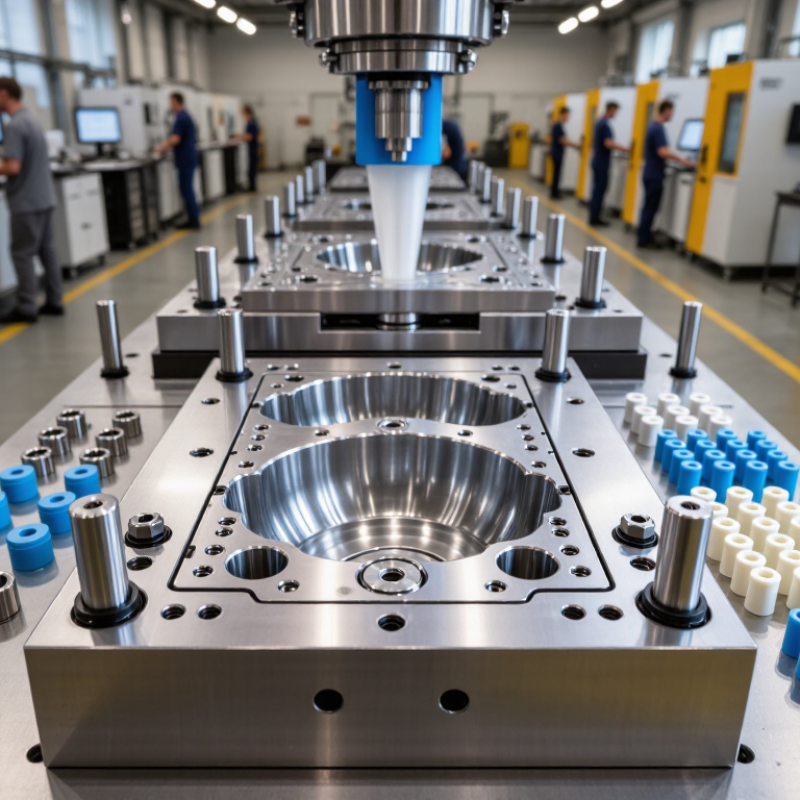
Global Scale: 400.3 Mt of Plastics Produced in 2022 (Plastics Europe)
Why Choose a Plastic Mold for Global Manufacturing?
Global Scale: 400.3 Mt of Plastics Produced in 2022 (Plastics Europe)
Plastics Europe reported 400.3 million metric tons of plastics production in 2022. This figure shows the enormous scale of modern manufacturing. It also reveals why repeatable plastic molding remains important. A well-designed mold can produce thousands of identical housings, clips, or medical components with controlled dimensions. Small details matter, including gate location, cooling channels, wall thickness, and ejection points.
Scale matters.
For global production, mold design supports consistent output across different facilities. Engineers can define material grades, inspection points, and acceptable tolerances before production begins. A reliable mold may reduce manual finishing, shorten cycle times, and limit variation between batches. It can also make shipping simpler when one compact component replaces several assembled parts. These benefits become valuable when production volumes rise quickly.
However, high volume does not guarantee responsible manufacturing. Poor cooling design can create warping, surface defects, and unnecessary scrap. Material selection may also be wrong for heat, impact, or chemical exposure. I have seen projects focus heavily on unit price while overlooking maintenance access and mold storage. That mistake becomes expensive later. Global teams should review repair requirements, local processing skills, energy use, and end-of-life options before approving a mold. The result may not be perfect. It should be measurable, maintainable, and suitable for the real conditions of each market.
| Geographic Dimension | Share of Global Plastics Production, 2022 | Approximate Production Volume | Manufacturing Context |
|---|---|---|---|
| World total | 100% | 400.3 million tonnes | A large global production base supports the use of plastic components across many industries and markets. |
| China | 32% | About 128.1 million tonnes | The largest regional share in the reported production breakdown. |
| Rest of Asia | 19% | About 76.1 million tonnes | A substantial regional production base alongside China. |
| NAFTA region | 17% | About 68.1 million tonnes | A major production region serving manufacturing and consumer markets. |
| Europe | 14% | About 56.0 million tonnes | A significant regional share of global plastics production. |
| Middle East and Africa | 8% | About 32.0 million tonnes | Part of the diverse worldwide production network. |
| Latin America | 4% | About 16.0 million tonnes | Contributes to global supply across regional markets. |
| Japan | 3% | About 12.0 million tonnes | Included as a separate region in the reported breakdown. |
| CIS | 3% | About 12.0 million tonnes | Included as a separate region in the reported breakdown. |
Source: Plastics Europe, Plastics — the Facts 2023. Regional production volumes are approximate calculations from the report’s rounded regional shares and the 400.3-million-tonne global total.
Related Posts
-
2026 Best Plastic Injection Die for Optimal Production效率?
-
Why Choose Injection Tooling for Global Sourcing?
-
Challenges Faced in Injection Tooling Manufacturing Process
-
Driving Innovation in Injection Tooling at the 138th Canton Fair 2025 with Industry Data Insights
-

Best Die Mold Types for Precision Manufacturing and Efficiency?
-
What is a Plastic Injection Molding Die and How Does It Work?