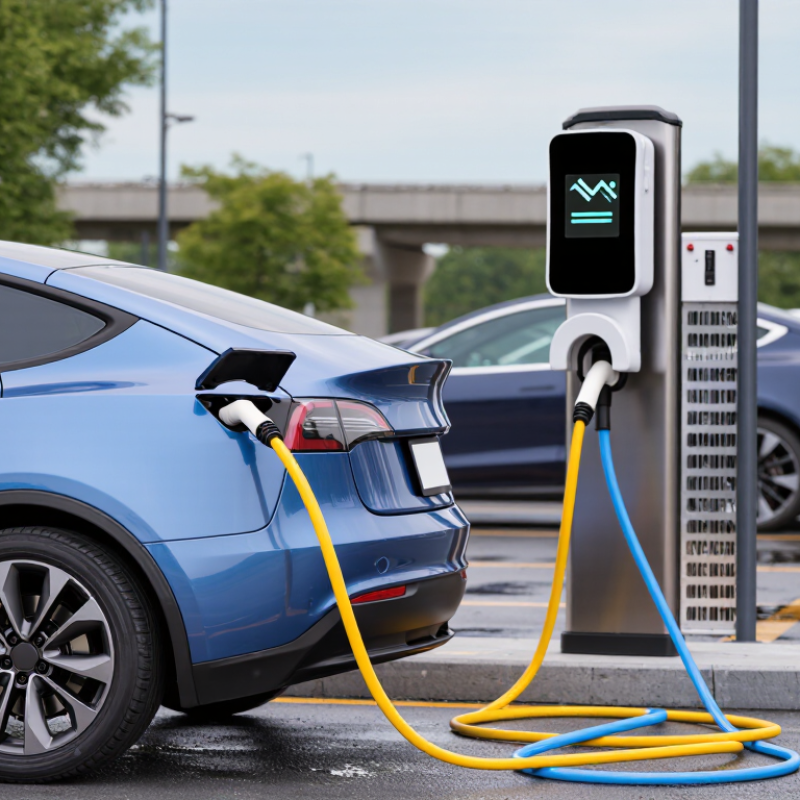
| Definition of a rapid EV charger | Usually a DC charger delivering approximately 50 kW or more | It supplies direct current to the vehicle battery instead of relying mainly on the vehicle’s onboard AC charger. | Confirm the vehicle’s maximum DC charging rate before paying for higher output. |
| AC charging comparison | Approximately 3.6–22 kW, depending on the vehicle and electrical supply | AC power is converted to DC by the onboard charger inside the vehicle. | Choose AC for overnight, workplace, or long-stay charging; choose DC for rapid travel stops. |
| Common DC power classes | 50–149 kW: rapid; 150–349 kW: high-power; 350 kW and above: very high-power | Higher rated power can reduce charging time, but only when the vehicle and battery can accept it. | For most passenger vehicles, 100–200 kW is often a practical balance between speed, site cost, and vehicle capability. |
| Charging process | Grid AC → power electronics → controlled DC output → battery management system | The charger and vehicle continuously exchange information about voltage, current, temperature, and battery limits. | Select equipment that supports recognized communication and safety requirements for the target vehicle market. |
| Typical charging voltage | Approximately 400 V or 800 V vehicle systems | At the same power level, a higher-voltage system generally requires less current, which can reduce cable and thermal demands. | Check whether the charger output range matches the vehicle’s battery voltage architecture. |
| Charging connector | Use the regional DC connector standard supported by the vehicle | Physical compatibility and communication compatibility are both required for charging to begin. | Verify connector type, cable reach, locking method, and whether an approved adapter is permitted. |
| Vehicle charging limit | The vehicle may accept less power than the charger’s maximum rating | Actual charging power is limited by the lowest active limit among the charger, vehicle, battery temperature, state of charge, and electrical supply. | Use the vehicle manual or technical specification rather than selecting a charger by output alone. |
| Charging curve | Power is usually highest at a low or medium state of charge and tapers near full charge | The final portion of charging generally takes disproportionately longer than the first portion. | For long-distance travel, charging from about 10% to 80% is often more time-efficient than charging to 100%. |
| Illustrative charging-time calculation | 60 kWh battery charged from 10% to 80% requires approximately 42 kWh | Ideal time is calculated as energy required ÷ charging power: 42 kWh ÷ 50 kW ≈ 50 minutes; 42 kWh ÷ 150 kW ≈ 17 minutes. | Treat these figures as theoretical estimates; real sessions are longer because of tapering, battery temperature, and conversion losses. |
| Energy efficiency | Charging losses commonly occur in the power electronics, cables, cooling system, and battery | Energy drawn from the grid is higher than the energy stored in the battery. | Compare measured energy delivered, standby consumption, and efficiency data under realistic operating conditions. |
| Thermal management | Air-cooled or liquid-cooled cables and power modules | Cooling helps maintain safe temperatures during sustained high-power charging. | For frequent high-power use, evaluate thermal derating, cable weight, cooling noise, and maintenance requirements. |
| Electrical installation | Requires suitable grid capacity, protection equipment, earthing, isolation, and often three-phase supply | The site’s available electrical capacity can be lower than the charger’s nameplate rating. | Obtain a site assessment and check local electrical codes before installation. |
| Safety and compliance | Relevant requirements may include IEC 61851, local electrical regulations, residual-current protection, and overcurrent protection | Safety systems detect insulation faults, overtemperature, abnormal voltage, connector problems, and communication errors. | Use certified equipment installed and commissioned by qualified professionals. |
| User authentication and payment | Contactless payment, mobile application, QR code, account login, or vehicle-based authentication | The available payment method affects convenience, access, and transaction reliability. | Choose a charger with at least one simple payment method and a clear display of price and session status. |
| Connectivity and monitoring | Ethernet, cellular, Wi-Fi, remote diagnostics, usage records, and software updates | Connectivity allows operators to monitor availability, energy use, faults, and pricing remotely. | For commercial sites, prioritize open communication protocols, remote support, cybersecurity, and data export. |
| Outdoor durability | Look for suitable ingress protection, impact resistance, corrosion resistance, and operating-temperature ratings | Outdoor equipment must withstand rain, dust, temperature changes, accidental impact, and repeated use. | Match the enclosure and connector ratings to the local climate and installation environment. |
| Best use case | Highway stops, fleet depots, taxi operations, service areas, and locations with short dwell times | Rapid DC charging is most valuable when vehicles need meaningful range added in a limited period. | Select power based on expected dwell time, traffic volume, vehicle mix, grid capacity, and total operating cost. |