What Is China Best Known for in the Engineering Industry?
China is widely recognized for the scale and speed of its engineering achievements. Its high-speed rail network connects major cities with precise scheduling and advanced track systems. Massive bridges cross wide rivers, deep valleys, and busy coastal channels. These projects reflect strong capabilities in structural design, construction management, and large-scale logistics.
The country is also prominent in renewable energy engineering. Large solar farms cover dry inland regions, while offshore wind turbines operate along developed coastlines. China’s manufacturing strength supports batteries, electric vehicles, power equipment, and industrial robotics. In the digital field, engineers combine cloud platforms, artificial intelligence, and smart sensors with factories and transport systems. The engineering industry benefits from dense supply chains and substantial public and private investment.
Scale alone does not prove excellence. Important questions remain. How can projects reduce environmental pressure, improve long-term maintenance, and protect worker safety? Some infrastructure develops faster than local demand, while quality can differ between regions and contractors. These weaknesses deserve honest attention. Reliable evaluation should examine lifecycle costs, verified performance, safety records, and community effects. China’s engineering reputation is therefore built on remarkable delivery, but it is still evolving. The clearest view includes both impressive results and unfinished challenges. This balanced perspective helps explain what China is best known for in engineering, without treating every achievement as universally successful.
China’s Engineering Scale: RMB 3.33 Trillion in R&D Spending in 2023
China’s engineering industry is best known for scale, speed, and its ability to connect research with construction. In 2023, national research and development spending reached RMB 3.33 trillion, according to official statistics. That figure covers basic research, applied studies, and experimental development across many sectors. It signals a sustained national effort rather than a short campaign. The scale is unmistakable. For engineers, this funding can mean larger laboratories, better testing equipment, and faster movement from a drawing board to a working prototype.
R&D spending also supports China’s extensive engineering workforce. A bridge project, energy system, or advanced manufacturing line often requires civil, electrical, software, and materials specialists working together. In practice, this coordination can shorten design cycles and expand the number of projects tested at once. Researchers may compare materials under heat, pressure, vibration, or repeated use before public installation. These steps build technical evidence. They also reveal weaknesses early, when repairs cost less.
Still, investment alone cannot guarantee excellent engineering. A large budget may produce impressive output, but uneven quality remains a concern. Some projects need stronger independent review, clearer data, and longer field testing. That gap matters. Engineering decisions affect public safety, operating costs, and environmental performance for decades. China’s continuing challenge is turning RMB 3.33 trillion into dependable results, transparent evaluation, and designs that perform beyond controlled conditions.
High-Speed Rail Leadership: Over 45,000 Kilometers in Operation by 2023
China is best known in engineering for its high-speed rail leadership. By the end of 2023, its high-speed rail network exceeded 45,000 kilometers, according to national transport statistics cited in the China Statistical Yearbook 2024. That distance is longer than many national railway systems combined. The International Union of Railways also identifies China as the world’s largest high-speed rail market by operating length.
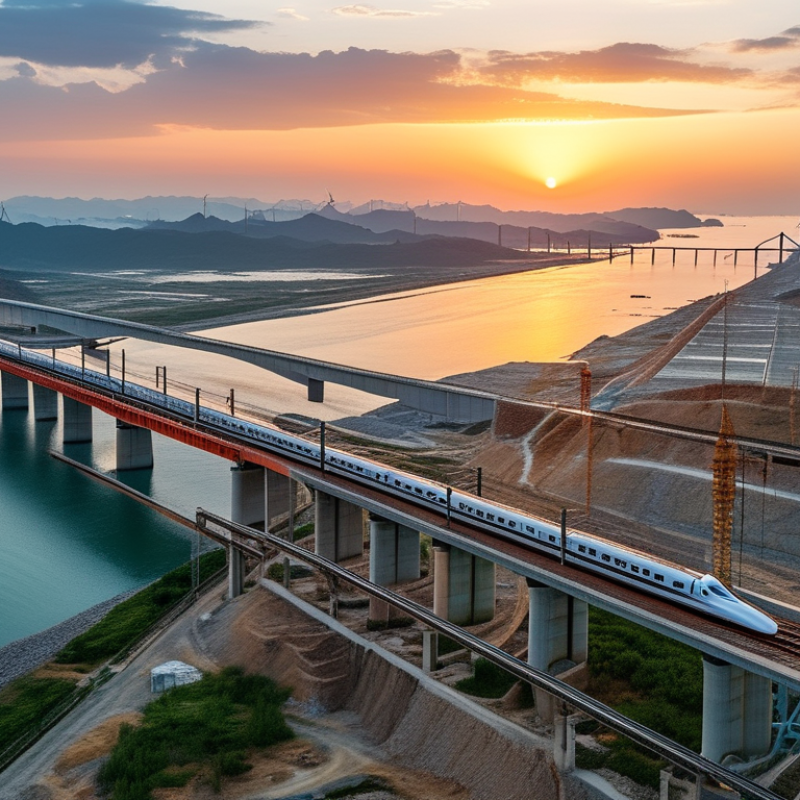
The achievement is not only about track. Engineers have coordinated viaducts, tunnels, signaling systems, power supply, and automated inspection. On a typical route, trains cross wide rivers, cut through mountains, and maintain stable speed across long bridges. The World Bank has reported that China’s high-speed rail development reduced travel times and improved connections between major economic regions. Dense passenger demand helped justify the investment.
Numbers can still hide weaknesses. A longer network requires heavier maintenance, stricter emergency planning, and careful lifecycle budgeting. Extreme heat, flooding, and uneven regional demand create practical pressure. A 350-kilometer-per-hour design may look impressive, yet reliability depends on small details, including drainage, wheel alignment, and platform safety. The 45,000-kilometer figure is powerful evidence, but it should not end the engineering discussion. Cost control and long-term renewal deserve equal attention.
What Is China Best Known for in the Engineering Industry?
High-Speed Rail Leadership: Over 45,000 Kilometers in Operation by 2023
China's high-speed rail network expanded rapidly from 7,531 kilometers in 2010 to approximately 45,000 kilometers in 2023, making it the world's largest high-speed rail network by operating length. Values are rounded publicly reported national totals.
Advanced Manufacturing: China’s 2023 Industrial Output and Global Share
China’s engineering reputation rests heavily on advanced manufacturing at extraordinary scale. In 2023, industrial value added increased 4.6% year on year, according to China’s National Bureau of Statistics. Manufacturing value added grew 5.0%, despite weaker external demand and uneven domestic recovery. These figures describe production momentum, not simply factory size.
UNIDO’s International Yearbook of Industrial Statistics places China’s share of global manufacturing value added at roughly one-third in recent estimates. That position supports dense supply networks for machinery, electronics, vehicles, energy equipment, and industrial components. The International Federation of Robotics reported 276,288 industrial robots installed in China during 2023. This represented more than half of global installations that year. On a production floor, the change appears practical: robotic arms repeat welding cycles, machine-vision systems inspect surfaces, and automated conveyors move parts between stations.
The picture is powerful, but incomplete. Scale can hide uneven productivity, especially among smaller factories and inland production clusters. High robot installations also do not guarantee better engineering judgment or safer process control. The data measures investment and output more clearly than durability, worker training, or long-term efficiency. China’s strongest advantage may therefore be its ability to test advanced equipment across many factories, then reduce costs through repetition. That advantage still requires careful maintenance, skilled technicians, and better measurement. Metrics can look impressive. Factory performance is less uniform.
Digital Infrastructure: More Than 3.38 Million 5G Base Stations by 2023
China is widely known for engineering at massive scale, and its digital infrastructure shows this clearly. By the end of 2023, the country had more than 3.38 million 5G base stations, according to publicly reported official figures. These sites support dense city districts, industrial parks, transport hubs, and remote communities.
The engineering challenge is not only installing equipment. A base station needs stable power, fiber or wireless backhaul, weather protection, and careful frequency planning. In busy streets, engineers measure signal strength around buildings and tunnels. On factory floors, they test low-latency connections for machines and sensors. Rural projects may require taller structures and longer maintenance routes. Small details matter.
Scale brings useful experience, but it can also create blind spots. More towers do not automatically mean equal service everywhere. Indoor coverage, network congestion, energy use, and repair access still require constant evaluation. Some rural users may see weaker performance despite impressive national figures. That gap deserves honest attention. Engineers must also plan for equipment replacement and growing data demand, not just today’s connection targets. The result is a living infrastructure system, expanding through repeated testing, field adjustments, and lessons from imperfect deployments.
What Is China Best Known for in the Engineering Industry? — Digital Infrastructure: More Than 3.38 Million 5G Base Stations by 2023
| Year-End |
5G Base Stations
(million) |
Total Mobile Base Stations
(million) |
5G Mobile Users
(million) |
Internet Users
(million) |
Fixed Broadband Users
(million) |
| 2019 |
0.13 |
8.42 |
1 |
904 |
449 |
| 2020 |
0.72 |
9.31 |
200 |
989 |
483 |
| 2021 |
1.43 |
9.96 |
355 |
1,032 |
508 |
| 2022 |
2.31 |
10.83 |
575 |
1,067 |
590 |
| 2023 |
3.38 |
11.65 |
805 |
1,092 |
636 |
|
Notes: Figures refer to year-end totals and are rounded where appropriate. “5G mobile users” refers to mobile subscribers using 5G services. The 2023 figure of approximately 3.38 million 5G base stations is equivalent to more than 3.38 million nationwide. Sources: China’s Ministry of Industry and Information Technology (MIIT) annual communications industry statistics and the China Internet Network Information Center (CNNIC) statistical reports.
|
Renewable Energy Engineering: 1.516 Billion Kilowatts Installed by 2023
What Is China Best Known for in the Engineering Industry?
Renewable Energy Engineering: 1.516 Billion Kilowatts Installed by 2023
China’s renewable energy engineering stands out for its scale, speed, and complex system design. By the end of 2023, reported renewable capacity reached 1.516 billion kilowatts. This figure included hydropower, wind power, solar power, and biomass generation. It represented more than impressive construction. It required millions of panels, thousands of turbines, reinforced foundations, and carefully planned substations.
The engineering challenge begins after installation. Solar and wind output changes with sunlight and weather. Engineers therefore combine forecasting software, energy storage, flexible power plants, and long-distance transmission lines. In remote areas, a single project may involve mountain roads, desert foundations, dust control, and difficult maintenance access. Grid operators must also balance electricity within seconds. Small errors can become expensive.
The number is powerful, but incomplete. Installed capacity does not equal actual electricity production. Some renewable projects still face curtailment, limited storage, or weak local grids. Land use and equipment recycling need more attention too. A turbine may operate for decades, while its blades create a harder waste problem. Better performance data should be published openly. Independent inspections also matter. Engineering progress is real, but the industry still has practical gaps to repair.