2026 Top Oil Rubber Hose Manufacturers for Global Buyers
The 2026 global Oil Rubber Hose market demands more than attractive prices and polished product catalogs. Buyers must examine construction, application limits, traceability, and after-sales support. A hose carrying crude oil across a hot terminal faces different stresses from one installed on a mobile drilling unit. Temperature changes, abrasive surfaces, pressure surges, bending, and chemical exposure can shorten service life quickly.
Dr. John S. Dick, a respected rubber technology author, has noted, “A hose is only as reliable as its materials, construction, and service conditions.” This principle remains practical for international procurement. Manufacturers should explain their rubber compound, reinforcement layers, working pressure, burst pressure, operating temperature, bend radius, and compatibility data. They should also provide consistent batch records and credible test documentation. Clear details matter.
Not every “top manufacturer” is the best fit. A large factory may offer impressive capacity, yet weak communication can delay urgent replacements. A smaller supplier may provide better customization, but limited testing resources could create uncertainty. No ranking is perfect. That deserves attention.
This guide reviews leading Oil Rubber Hose manufacturers for global buyers in 2026. It considers product reliability, engineering experience, certification practices, production capability, customization, logistics, and buyer support. It also recognizes an uncomfortable reality: specifications on paper cannot replace field experience. Buyers should request samples, verify documents, and confirm performance under actual service conditions. Careful comparison reduces costly surprises, though it cannot remove every risk.
Oil Rubber Hose Manufacturing: Types, Materials, and Core Applications
Oil Rubber Hose Manufacturing: Types, Materials, and Core Applications
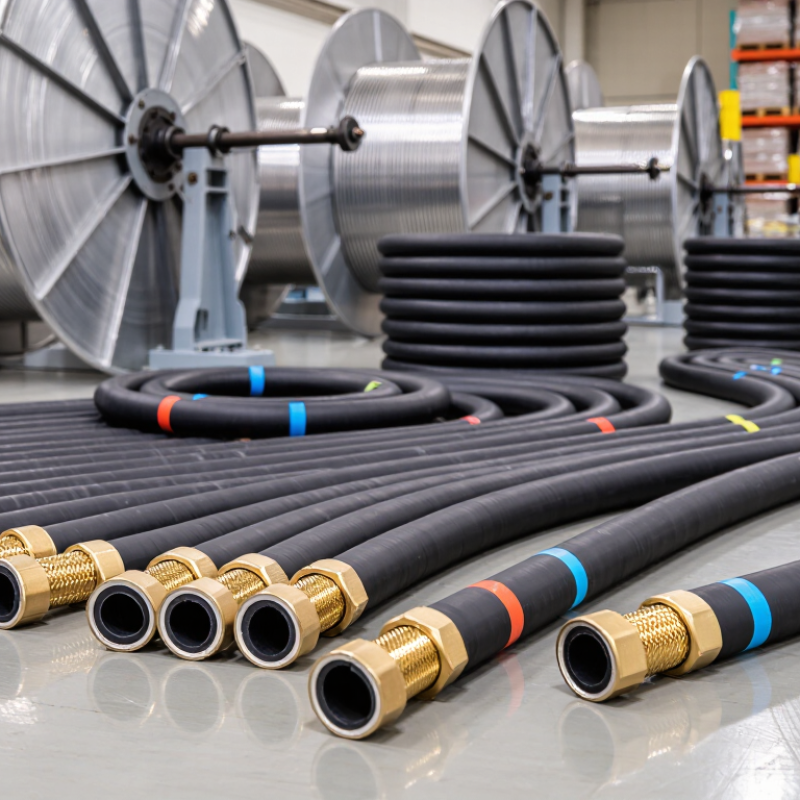
Oil rubber hose manufacturing begins with service conditions, not appearance. Common types include fuel delivery, hydraulic oil, suction and discharge, drilling fluid, and tanker loading hoses. Each design balances flexibility, pressure resistance, abrasion protection, and chemical compatibility. A smooth inner tube supports steady flow and easier cleaning. A corrugated cover improves bending, but may reduce external abrasion resistance. That trade-off matters.
Nitrile rubber is widely selected for petroleum oils because it resists swelling and maintains useful flexibility. Neoprene or chloroprene covers can handle weathering and moderate oil exposure. EPDM suits heat, water, and some chemicals, but it is generally unsuitable for petroleum-based fluids. Reinforcement may use textile plies, steel wire, or multiple layers. Wire construction supports higher pressure, while textile reinforcement often offers lighter handling. Manufacturing quality depends on compound mixing, extrusion, calendaring, braiding, vulcanization, and final pressure testing. Small process errors matter.
In refineries, hoses connect transfer lines, pumps, and maintenance equipment. Ports use them for fuel loading and controlled transfer operations. Mobile service units need compact hydraulic oil hoses near moving machinery. Buyers should verify fluid type, temperature, pressure, bend radius, coupling design, and electrical continuity where required. Ask for batch traceability and test records. Do not rely on catalog pressure alone. A hose may pass a factory test yet fail after repeated bending, heat, or poor storage. Specifications are sometimes copied without checking the actual oil blend. That is an avoidable weakness.
2026 Top Oil Rubber Hose Manufacturers for Global Buyers
Oil Rubber Hose Manufacturing: Types, Materials, and Core Applications
The chart compares representative upper continuous service temperatures for common rubber compounds used in oil hose construction. NBR is widely selected for petroleum oils and fuels, FKM for higher-temperature or chemically aggressive oil service, EPDM for heat and weather resistance where petroleum oils are not involved, and CR for general-purpose oil-resistant applications. Actual ratings depend on hose reinforcement, pressure, fluid composition, and applicable standards.
How to Evaluate Oil Rubber Hose Manufacturers in 2026
2026 Top Oil Rubber Hose Manufacturers for Global Buyers
How to Evaluate Oil Rubber Hose Manufacturers in 2026
Evaluating oil rubber hose manufacturers requires more than comparing prices and product photos. Check whether the factory understands oil type, operating temperature, pressure cycles, and installation conditions. Ask for evidence.
A reliable manufacturer should provide material specifications, reinforcement details, dimensional tolerances, and test records. Verify resistance against abrasion, weathering, fuel, and hydraulic fluid when relevant. Independent laboratory reports can strengthen these claims, but they should match the exact hose construction. Generic certificates are not enough.
Inspect production controls carefully. Review rubber mixing, reinforcement placement, curing records, and final pressure testing. Request samples from normal production, not specially prepared units. Small details matter. Check markings, packaging, bend radius, and end-fittings. These details often reveal process discipline.
Assess technical communication as well. Skilled engineers should explain failure risks without hiding uncertainty. A supplier that admits a material limitation may be safer than one promising universal performance. Delivery history, traceability, complaint handling, and replacement procedures also deserve written review. Do not guess.
Factory audits can confirm equipment and workflow, but one visit cannot prove long-term consistency. Repeated sample testing is wiser, although it increases purchasing time. Buyers should document every requirement and compare results objectively. A low quotation may become expensive after leakage, downtime, or premature replacement. Experiences from field use should guide the final decision, yet even experienced teams should revisit old assumptions when applications change.
Top Global Oil Rubber Hose Manufacturers and Their Strengths
Global Oil Rubber Hose Manufacturers and Their Strengths
Top global oil rubber hose manufacturers compete through material control, testing discipline, and consistent production. Their strongest products usually combine oil-resistant inner tubes with reinforced textile or steel layers. These structures help hoses manage pressure, vibration, and repeated bending in demanding equipment.
Manufacturers in established industrial regions often provide detailed technical data, batch traceability, and customized dimensions. Their engineers may adjust rubber compounds for diesel, hydraulic oil, or high-temperature service. Some facilities use automated extrusion lines and pressure-testing equipment. Others depend more on experienced technicians. Both approaches can work, but consistency remains critical.
During supplier evaluations, buyers should inspect hose markings, wall thickness, bend radius, and fitting quality. A reliable factory should explain its test methods clearly. Ask for pressure ratings, temperature limits, chemical compatibility, and inspection records. Samples should be checked after bending and heat exposure, not only when new. Small details matter.
Cost still influences purchasing decisions. However, a lower quotation may hide weaker reinforcement or unstable rubber quality. One practical concern is aging inventory. Even a well-made hose can lose flexibility after poor storage. This point is sometimes overlooked.
No manufacturer performs perfectly in every application. A supplier may offer excellent oil resistance but limited customization. Another may provide fast production but weaker documentation. Buyers should compare real operating conditions, not attractive catalog claims. Careful communication prevents expensive assumptions.
Quality Standards, Testing, and Certification Requirements
For global buyers, oil rubber hose quality begins with correct application matching. A hose for fuel transfer may require different compounds, pressure ratings, and cover materials. Manufacturers should identify the service fluid, temperature range, working pressure, bending radius, and exposure conditions. These details must appear in the technical datasheet, not only in sales discussions.
Testing should include hydrostatic pressure, leakage, burst strength, adhesion, abrasion, and dimensional checks. Suction hoses also need vacuum resistance testing.
Each test should show the method, equipment, acceptance criteria, and batch number. Relevant ISO, EN, SAE, or API requirements may apply, depending on the intended service. Buyers should request current reports from qualified laboratories. A factory certificate alone is not enough.
Certification needs careful review. ISO 9001 demonstrates quality-management control, but it does not automatically certify every hose product. Product approvals, material declarations, and third-party inspection records provide stronger evidence. Traceability matters. The manufacturer should link the hose, reinforcement wire, compound batch, test results, and shipment records. During an audit, small gaps often appear in labeling or document control. These gaps deserve attention. A perfect file can still hide weak production discipline, so buyers should inspect samples, witness testing when possible, and repeat critical checks after design changes.
